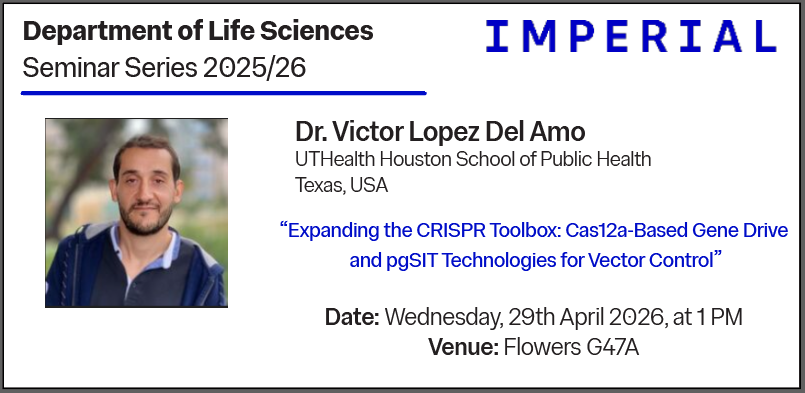
Seminar: Expanding the CRISPR Toolbox: Cas12a-Based Gene Drive and pgSIT Technologies for Vector Control
DoLS Seminar 30 April
Speaker
Dr. Víctor López del Amo
UTHealth Houston School of Public Health, Texas, USA
Title
“Expanding the CRISPR Toolbox: Cas12a-Based Gene Drive and pgSIT Technologies for Vector Control”
About the Speaker
Dr. Víctor López del Amo is an Assistant Professor of Epidemiology at UTHealth Houston School of Public Health, where he develops CRISPR-enabled genome engineering tools for genetic population control and vector biology. He earned a PhD in Biomedicine & Biotechnology from the University of Valencia (Spain), and completed postdoctoral training at UC San Diego. His research has pushed gene drive technology beyond conventional Cas9 by developing systems based on nickase Cas9 and Cas12a, and he is now advancing base editing for insect models and mosquito vectors. His publication record spans CRISPR gene drives and base editing, including A temperature-sensitive CRISPR-Cas12a system for sterile insect technique (Nature Communications, 2025), Next-generation CRISPR gene-drive systems using Cas12a nuclease (Nature Communications, 2023), A nickase Cas9 gene-drive system promotes super-Mendelian inheritance in Drosophila (Cell Reports, 2022), and Expanding the CRISPR base editing toolbox in Drosophila melanogaster (Communications Biology, 2024). He is also an inventor on patent applications covering temperature-controllable insect suppression/modification (WO2023064084A1), delayed CRISPR activation to improve gene drive effectiveness (WO2023060058A1), and a nickase-based gene drive system (WO2023064706A1.
Abstract:
CRISPR-based technologies have transformed our ability to manipulate insect genomes for population control and disease reduction. In this seminar, I will describe how Cas12a can be used as a flexible and efficient alternative to Cas9 for implementing both gene drive and precision-guided sterile insect technique (pgSIT) strategies. Cas12a offers distinct advantages, including simplified guide RNA architecture, expanded targeting capabilities, and temperature-dependent activity. These examples illustrate how Cas12a can support both self-propagating and self-limiting genetic control strategies. Overall, this work highlights the versatility of Cas12a as a platform for developing novel genetic technologies in insects.
Contact
Please contact host Agela Meccariello (a.meccariello@imperial.ac.uk) if you would like to meet with the speaker.